How the SlumberPal sleep clock works: stars and sunrise
Bedtime
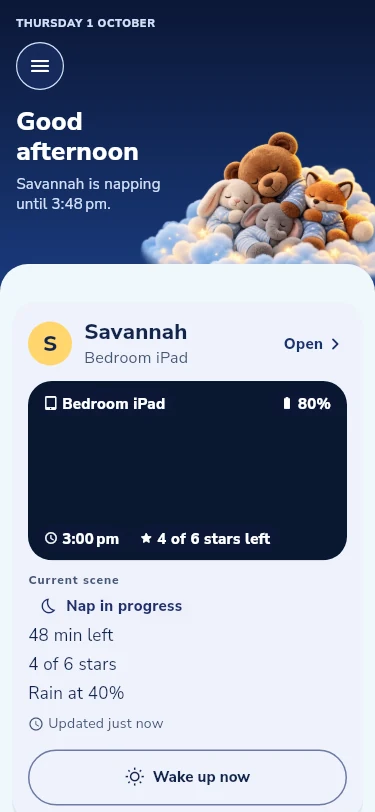
Their pal settles down and six stars light up.


Sleep time
The stars go out one by one as sleep time passes. While any are left, it’s still night.
Morning
The sun comes up and their pal shows it’s OK to get up. A present appears, with a toy for the shelf.
Pyjama Ted’s night and day scenes are the app’s own. Press play on the clips to see them move.
SlumberPal is an OK-to-wake clock, or sleep trainer clock, that runs on a tablet you already have. Above: what the child sees. Below: how you set it up and what each part does. It has two sides. Parent mode, on your phone or tablet, is where you set up the family, the sleep times, the sounds and the pal. The Pal Screen, on the bedroom tablet, is what your child sees: the pal, the stars, one gentle activity and the sounds, with the grown-up controls behind the grown-up PIN.
Bedtime, every night
- At bedtime the pal settles and six stars glow. They go out one by one while your child falls asleep.
- When the sun comes up, the pal shows it is OK to get up. You choose the times in the schedule in Parent mode, for bedtime and for naps.
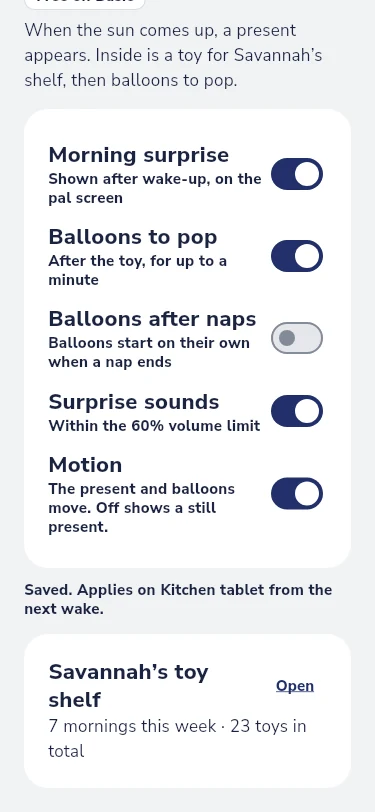
- A present appears. Inside is a toy for your child’s shelf, then balloons to pop. You can turn the surprise, the balloons and its sounds on or off at any time. Toys on the shelf stay there, even if Plus ends.
Setting up a bedroom screen
Open SlumberPal on the bedroom tablet and choose to set it up as a Pal Screen. It shows a code. In Parent mode, open Devices and add a screen by scanning that code. The camera is used only to scan the code. If you only have one tablet, you can use that device as the Pal Screen instead.
Your family has one six-digit grown-up PIN. Every Pal Screen in your family accepts it, and each screen checks it on the screen itself, even offline. To reach the grown-up controls on a screen, hold the padlock and enter the PIN.
From your phone
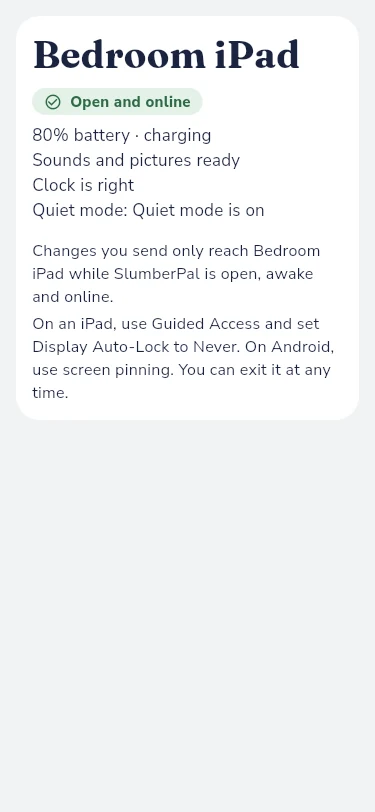
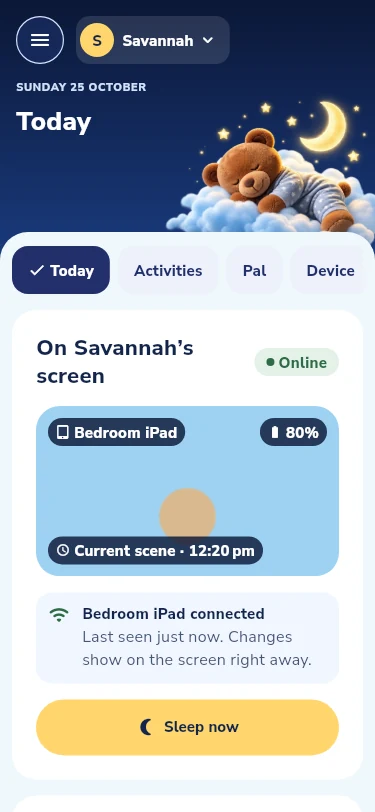
From Parent mode you can send an action to a screen, such as starting an activity or a wake. It applies only while SlumberPal is open on that screen, the screen is awake and the tablet is online. If the app is closed, the screen is locked or the tablet is offline, the action waits until it expires and Parent mode tells you it did not apply. This is how phones and tablets work, not a fault. On Android, screen pinning keeps SlumberPal open, and you can exit it.
Sounds
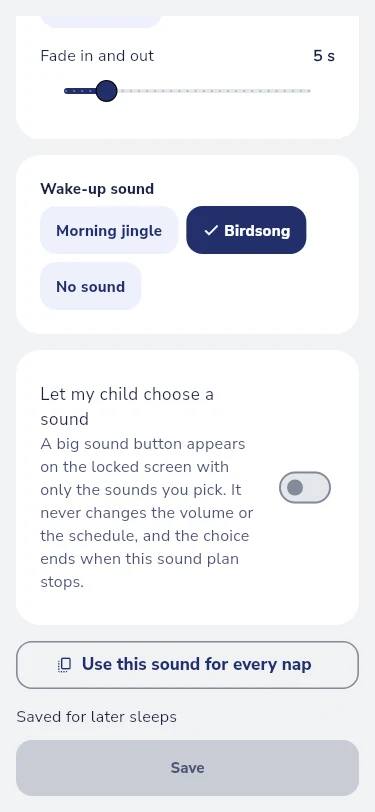
You can choose a sound for each sleep, such as noise, nature or a lullaby, and when it stops. A wake sound is short. SlumberPal starts quiet and never plays above a volume cap that you can lower. It never changes the tablet’s own volume, so set that low and keep the tablet across the room. SlumberPal does not make any claim about safe listening levels.
Keeping the tablet quiet
Notifications and calls from other apps can wake a child, so set the bedroom tablet to be quiet while SlumberPal is open. On Android, SlumberPal asks once for Do Not Disturb access, then turns its own quiet mode on for each sleep and off at wake. Its sleep sounds keep playing. Clock alarms set on the tablet still ring. SlumberPal does its best here, and cannot promise that no other app will ever make a sound.
See it in action
A short video of SlumberPal in use, with captions and a transcript, is on its way. Until then, the Help articles inside the app cover every step above.